
What Is Mirror Therapy for Stroke, and Does It Work?
In this guide
This is general information, not medical advice. Always follow the guidance of your loved one's doctor, physiotherapist or occupational therapist.
If a physio or OT has mentioned mirror therapy, or you've seen it online, you're probably wondering whether a simple mirror can really help a weak hand after a stroke. This guide explains what mirror therapy is, what the research actually says, and how South African families can try it safely at home with the treating team's support.
Key takeaways
- Mirror therapy uses a mirror to show the reflection of the strong hand moving, so the brain "sees" the weak hand moving too.
- A Cochrane review (2018) of 62 studies with 1,982 people found moderate-certainty evidence that it improves arm and hand movement and daily activities, when added to usual rehab.
- The benefits are modest, and there is not yet enough evidence to say how long they last.
- Because it relies on what the person sees, it can be tried even when the weak hand can hardly move.
- It is cheap and simple, but it works best as part of a programme set by a physio or OT, not on its own.
What is mirror therapy for stroke?
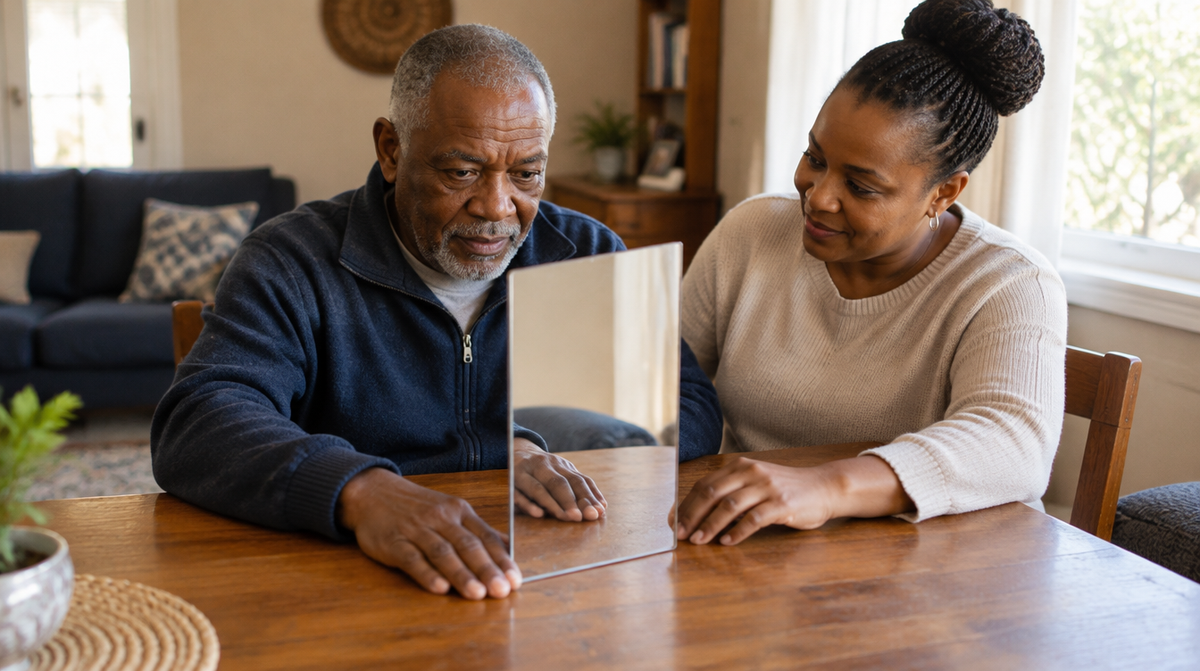
Mirror therapy is a rehabilitation exercise where a mirror is placed between the hands so the person sees the reflection of their strong hand where the weak hand should be. As the strong hand moves, it looks as if the weak hand is moving normally.
The weak hand sits behind the mirror or inside a mirror box, out of sight. The person keeps their eyes on the reflection while doing slow, simple movements: opening and closing the fingers, touching each finger to the thumb, turning the palm up and down, or tapping the table.
Where possible, the weak hand tries to copy the movement at the same time, even if it only moves a little. Researchers call this bilateral (two-handed) practice.
How is mirror therapy supposed to work?
The short answer is that seeing a movement seems to switch on some of the same brain areas as doing it. After a stroke, that visual "trick" may help the brain rebuild its movement pathways.
A 2020 review in Therapeutics and Clinical Risk Management (Gandhi and colleagues, 28 randomised trials) describes several possible explanations. One is the mirror neuron system, brain cells that fire both when we move and when we watch movement. Others include better attention to the weak side and changes in how active each side of the brain is. The authors are clear that these are still theories rather than proven mechanisms.
What matters for families is the practical result. Mirror therapy uses what the person sees, not what their hand can do, so it can be started even when the hand is very weak or barely moves. That same review notes it has been used in people with complete or severe weakness, and in the early, middle and long-term stages after stroke.

Does mirror therapy work? What the research says
Yes, for many people it seems to help, but the gains are usually modest. The strongest evidence comes from a Cochrane review, which pools the results of many trials and is one of the most trusted types of health evidence.
The Cochrane review (Thieme and colleagues, 2018) looked at 62 studies with 1,982 participants. Compared with usual care or other treatments, mirror therapy added to rehab led to:
- Better movement and function at the end of treatment (36 studies, 1,173 people), with moderate-certainty evidence.
- Less movement impairment, such as weakness and poor control (39 studies, 1,291 people), also moderate certainty.
- Better everyday activities like dressing and eating (19 studies, 622 people), with moderate-certainty evidence.
- Possibly less pain, but this evidence was low certainty.
- No clear benefit for visual neglect, where a person ignores one side of their space.
There are two honest limits. First, on one common arm test (the Fugl-Meyer upper limb assessment), the average extra gain was 4.32 points, a little below the roughly 5 points usually seen as a change people would notice. Second, only two small trials checked results six months later, so nobody can yet say how long the benefits last.
In short, mirror therapy is a reasonable, low-cost addition to rehab. It is not a cure, and it should not replace therapy.
Who might benefit, and who should be careful?
Mirror therapy may suit people with a weak arm or hand after stroke who can sit upright, concentrate for 10 to 20 minutes and follow simple instructions. It has been studied in early recovery and years after a stroke.
It may be harder or less suitable if your loved one:
- Has significant confusion, memory problems or trouble understanding the exercise.
- Has serious vision problems or neglects one side of their space.
- Becomes very tired, frustrated or upset by the reflection.
- Has pain, swelling or skin problems in the weak hand.
The 2020 review reported that mirror therapy was generally well tolerated, with no serious side effects. Some people had short-lived tiredness, soreness or swelling in the weak arm. Ask the physio or OT whether it suits your loved one before you start.
How do you do mirror therapy at home?
Ask the treating therapist to show you the set-up and choose the movements. Once they have, the basic routine is simple and needs very little equipment.
1. Set up the mirror
Use a mirror box or a plain upright mirror, roughly 30 to 45 cm tall, on a table. Sit your loved one square to the table with the mirror between their arms, reflective side facing the strong hand. Put the weak hand behind the mirror, out of sight. Remove rings and watches from both hands so the reflection looks like the other hand.
2. Keep the eyes on the reflection
Ask them to look only at the mirror, not over it. It can take a minute for the illusion to "click". Some people find it helps to imagine that the reflection really is their weak hand.
3. Move slowly and simply
Start with easy movements: make a fist and open it, spread the fingers, touch each finger to the thumb, turn the palm up and down. Do each one slowly, around 10 times. If possible, the weak hand tries to copy at the same time.
4. Keep sessions short and regular
In the Cochrane review, trials used sessions of 15 to 60 minutes, three to seven times a week, for two to eight weeks. At home, many families find two or three short sessions a day easier than one long one. Follow your therapist's advice on how much to do.
5. Stop if something feels wrong
Stop if your loved one feels dizzy, confused, very tired or in pain, and mention it at the next appointment. For more ideas on fitting practice into the day, see our guide to helping a hand recover at home.
Why does home practice matter so much in South Africa?
Recovery needs lots of repetition, and for many families most of that has to happen at home. The Heart and Stroke Foundation South Africa (2023) says about 10 people in the country have a stroke every hour, and around a quarter of stroke survivors are left with a life-changing disability.
Outside the big cities, therapy can mean long trips, transport costs and long waits, and medical aid benefits for rehab often run out. Mirror therapy is one of the few evidence-based exercises that costs very little and can be done at the kitchen table between appointments.
Where can a rehab glove fit in?
A plain mirror shows the brain movement, but the weak hand often stays still. Some families add a rehab glove so the weak hand also gets moved through the same motion, which keeps the fingers moving and adds repetitions on days when it's hard to sit and practise by hand.
The Mirra glove has a mirror mode: your loved one wears a sensor glove on the strong hand, and the rehab glove gently moves the weak hand in the same way at the same time. It is designed to support home practice alongside therapy. It does not replace a physio or OT, and results vary from person to person.
Check with the treating team first, especially if the hand is painful, swollen, very stiff, has open wounds, or can't be gently straightened.
Mirra home hand practice
Take mirror practice a step further at home
Mirra's mirror mode lets the strong hand lead while the glove gently moves the weak hand the same way, so both hands practise together, alongside your therapist's advice. Free tracked delivery anywhere in South Africa and a 30-day home trial.
Not sure if it's right for your family? Ask us a question
When should you call a doctor or therapist?
- The weak hand or arm becomes more painful, swollen, red or hot.
- The hand gets much tighter or more curled over a few weeks.
- Your loved one feels dizzy, confused or distressed during mirror practice.
- Shoulder pain on the weak side starts or gets worse.
- Any sudden new weakness, numbness, facial drooping, slurred speech, loss of balance or vision problems. This is an emergency: call an ambulance straight away.
Frequently asked questions
Can you do mirror therapy with just a normal mirror?
Yes. Many trials used a simple mirror or mirror box. A sturdy, upright mirror on a table is enough, as long as it hides the weak hand and shows a clear reflection of the strong one. Ask your therapist to check the set-up.
Is it too late to try mirror therapy years after a stroke?
Not necessarily. Mirror therapy has been studied in people in the early, middle and long-term stages after stroke. Gains may be smaller later on, so talk to the treating team about realistic goals.
How long before you see results?
Trials in the Cochrane review ran for two to eight weeks. Some people notice small changes within weeks, others don't. Keep a simple diary of what the hand can do so you and the therapist can judge progress.
Does mirror therapy help with pain after a stroke?
Possibly. The Cochrane review found some reduction in pain, but the evidence was low certainty. Pain should always be checked by a doctor or therapist rather than treated on its own at home.
Sources
- Cochrane: Thieme H, Morkisch N, Mehrholz J, et al. Mirror therapy for improving motor function after stroke. Cochrane Database of Systematic Reviews, 2018.
- PEDro (Physiotherapy Evidence Database): Systematic review found that mirror therapy improves motor function after stroke, summary of the 2018 Cochrane review.
- Gandhi DBC, Sterba A, Khatter H, Pandian JD. Mirror therapy in stroke rehabilitation: current perspectives. Therapeutics and Clinical Risk Management, 2020.
- Heart and Stroke Foundation South Africa. World Stroke Week 2023 press release, 2023.
Keep the hand practising every day
Try Mirra at home for 30 days, with free tracked delivery anywhere in South Africa.
Try Mirra at home