
When Can You Drive After a Stroke in South Africa?
In this guide
This guide is general information, not medical or legal advice. Always follow the advice of your loved one's doctor, physio or OT about when it is safe to drive.
For many South Africans, driving means independence: getting to work, church, the shops or the clinic without waiting for a lift. So one of the first questions after a stroke is often "When can I drive again?" This guide explains what the law says, what makes driving unsafe, and how to get a proper assessment.
Key takeaways
- South African law has no fixed waiting period after a stroke, but the National Road Traffic Act says you may not hold a licence if a disease or physical defect makes you unable to drive safely.
- Nobody should drive until their doctor confirms they are medically fit. As a guide, the UK's Stroke Association says car drivers there must wait at least one calendar month.
- Hidden effects such as one-sided vision loss, neglect, slow thinking, seizures and tiredness are often more dangerous behind the wheel than a weak arm.
- An occupational therapist (OT) can do a driver evaluation, and many people with weakness can drive again with an automatic car or adaptations.
- Tell your car insurer about the stroke, and plan other transport while you wait so the person you care for stays connected.
When can you drive after a stroke in South Africa?
There is no set number of weeks in South African law. The rule is simple but strict: a person should not drive until their doctor is satisfied they are fit to drive, and many doctors will also want an OT driving assessment first.
Some countries do set a minimum. In the UK, the Stroke Association explains that car and motorbike drivers must not drive for at least one calendar month after a stroke or TIA (mini-stroke), and some people must stop for longer or permanently. That one-month rule is not South African law, but it is a useful reminder that nobody should be driving in the first weeks.
Recovery is different for everyone. Someone with a small stroke and no lasting effects may be cleared fairly quickly. Someone with vision, thinking or seizure problems may need months, or may not be able to drive again. If you are still in the early days, our guide on what to expect in the first weeks after a stroke may help.
What does South African law say about driving after a stroke?
Section 15 of the National Road Traffic Act (1996) disqualifies a person from holding a driving licence if they have certain conditions. These include sudden attacks of disabling giddiness or fainting, uncontrolled epilepsy, muscular incoordination, vision below the prescribed standard, and "any other disease or physical defect" likely to make them unable to drive effectively.
The Act puts the responsibility on the driver. Section 16 says a licence holder who becomes aware that they are disqualified must hand in the licence to the licensing authority within 21 days. It is also an offence to knowingly hide a disqualification when applying for a licence.
In practice, this means a stroke does not automatically cancel a licence. What matters is whether its effects make driving unsafe. That is a medical question, so your loved one's doctor needs to be part of the decision. The Occupational Therapy Association of South Africa (OTASA, 2018) notes that medical practitioners are responsible for clearing medical fitness to drive, while OTs assess functional fitness.

Which stroke effects make driving unsafe?
The biggest risks are often the ones you cannot see. A person can walk well and still be unsafe in traffic because of vision, attention or thinking changes.
The Stroke Association lists these problems as important for driving:
- Visual field loss: missing part of the vision on one side, so a taxi or pedestrian on that side goes unseen.
- Neglect (visual inattention): the brain ignores one side of the world. People with neglect are not allowed to drive in the UK.
- Double vision.
- Thinking and memory changes: slower reactions, poor concentration, trouble judging gaps or following directions.
- Seizures: in the UK, a seizure within a week of a stroke means no driving for six months.
- Weakness, poor coordination or balance problems in the arm or leg.
Tiredness matters too. Post-stroke fatigue can make concentration drop suddenly, which is risky on a long drive. Read more in our guide to tiredness after a stroke.
How do you get a driving assessment in South Africa?
Start with the doctor, then ask for a referral to an OT who does driver evaluation and rehabilitation. OTASA's 2018 position statement describes OTs as the professionals who evaluate fitness to drive and recommend driver rehabilitation, vehicle adaptations, and whether a person should resume or stop driving.
1. Ask the doctor directly
At the next check-up, ask: "Is it safe for my dad to drive, and if not, what needs to happen first?" Ask the doctor to write down their advice.
2. Ask for an OT driver evaluation
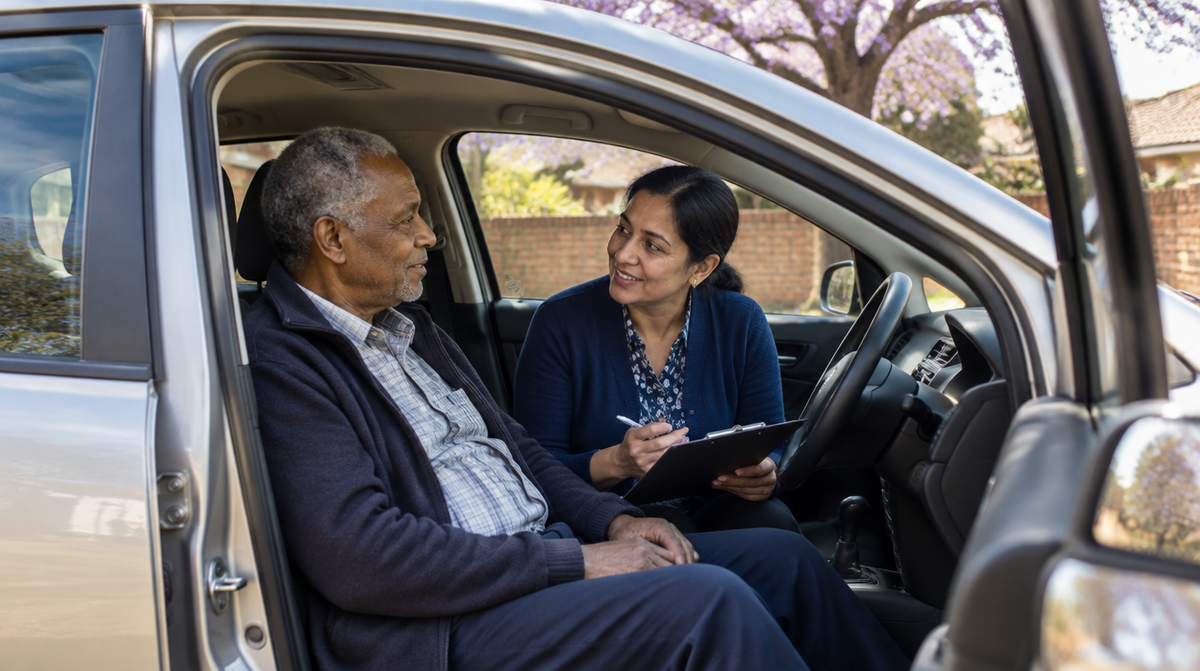
Not every OT does driving assessments. Ask your hospital rehab team, your loved one's OT or OTASA for someone who specialises in driver rehabilitation. An assessment usually looks at vision, reaction time, thinking skills and physical control, and may include time on the road.
3. Follow the recommendations
The outcome might be "ready to drive", "drive with an automatic or adapted car", "more rehab first" or "not safe to drive". Treat it as advice for safety, not a judgement of the person.
Very few people seem to get a formal check. A small US study presented at the International Stroke Conference (2014) found about half of 162 stroke survivors were driving within a year, but only 6% had a formal driving evaluation. That is a gap families can help close.
Can you drive with a weak hand or leg after a stroke?
Often, yes, with the right car and the right clearance. Many people with weakness on one side drive safely using an automatic car or adaptations such as a steering knob or a left-foot accelerator.
If an existing licence holder needs an adapted vehicle, the usual route in South Africa is to get a letter from a doctor or therapist, take it to the local licensing department, and do a practical retest. If they pass, the licence is restricted to an automatic or adapted vehicle as needed. Ask your OT to guide you through this.
Hand function also matters for everyday driving tasks such as gripping the wheel, using indicators and fastening a seatbelt. Keep up the hand exercises your therapist gives you; some families also use a rehab glove, such as Mirra, to help with daily repetitions at home. Check with your therapist first, and remember that no device replaces a driving assessment.
Evidence on driving rehab itself is still limited. A Cochrane review (2014) of 4 trials with 245 stroke survivors found insufficient evidence to say whether rehab improves on-road driving, though there was limited evidence that simulator training may help some driving-related skills.
What about car insurance after a stroke?
Phone your insurer before your loved one drives again. Tell them about the stroke and any changes to the car or licence. Read the policy's disclosure section, because not telling your insurer about a change in health could put a claim at risk. Keep a copy of the doctor's or OT's letter clearing them to drive.
How do you talk to Mum or Dad about not driving yet?
Lead with safety and with a plan, not with "you can't". Losing the car keys can feel like losing independence, so the conversation goes better when there is something to replace it.
- Let the doctor or OT deliver the news. It takes the pressure off you.
- Agree on a goal: "Let's get the assessment done so you can drive again safely."
- Draw up a lift roster with family, neighbours or church friends for regular trips.
- Budget for e-hailing or a trusted local driver for appointments.
- Keep the keys somewhere agreed if there is a risk they will drive before being cleared.
If the answer is that driving is no longer safe, give it time. It is a real loss, and the OT can help find other ways to stay independent. Our guide on occupational therapy vs physiotherapy explains what an OT can help with.
When should you call a doctor or therapist?
- Call 112 from a cellphone or 10177 for an ambulance straight away if you see new stroke signs: face drooping, arm or leg weakness, slurred speech, sudden loss of balance or sudden vision loss. See our BE FAST guide.
- Your loved one has a seizure, faints or has sudden dizzy spells.
- You notice new vision problems, such as bumping into things on one side.
- They seem confused, very drowsy or are making unsafe decisions.
- They are planning to drive and have not yet been cleared.
- They had a near-miss or a minor accident after starting to drive again.
Frequently asked questions
Do I have to report a stroke to the licensing department in South Africa?
There is no automatic reporting system for strokes. But under the National Road Traffic Act, a licence holder who knows they are disqualified must hand in their licence within 21 days. If you are unsure whether the stroke affects your fitness to drive, ask your doctor.
Can you drive after a mini-stroke (TIA)?
Do not drive until a doctor has checked you. A TIA is a warning sign of a possible stroke, so it needs urgent medical attention first. In the UK, the Stroke Association says the same minimum one-month break applies after a TIA as after a stroke.
Can my mum drive if she only has a weak left hand?
She may be able to, especially with an automatic car or a steering aid, but only after her doctor clears her medically. An OT driving assessment can check whether she has enough control and recommend adaptations.
Who does driving assessments after a stroke?
In South Africa, occupational therapists trained in driver evaluation and rehabilitation do functional driving assessments, while doctors clear medical fitness. Ask your hospital rehab team or OTASA for a referral.
Sources
- Government of South Africa, National Road Traffic Act 93 of 1996, Section 15: Disqualification from obtaining or holding a learner's or driving licence (1996, as amended)
- Government of South Africa, National Road Traffic Act 93 of 1996, Section 16: Failure to disclose disqualification (1996, as amended)
- Occupational Therapy Association of South Africa (OTASA), Enabling community mobility through driver evaluation and rehabilitation: the role of occupational therapists, South African Journal of Occupational Therapy (2018)
- Stroke Association (UK), Driving after a stroke (accessed 2026)
- Cochrane, Rehabilitation for improving automobile driving after stroke (2014)
- MDedge, Half of stroke survivors returned to driving, reporting a study presented at the International Stroke Conference (2014)

Keep the hand practising every day
Try Mirra at home for 30 days, with free tracked delivery anywhere in South Africa.
Try Mirra at home