
Occupational Therapy vs Physiotherapy After a Stroke: What's the Difference?
In this guide
This guide is general information, not medical advice. Always follow the advice of your loved one's doctor, physiotherapist or occupational therapist (OT).
After a stroke, your family may suddenly hear about "physio", "OT" and "speech" all at once, often from different people on the same ward. It can be hard to know who does what, which therapist to ask for, and what to do if your medical aid or local clinic only offers one. This guide explains the difference in plain language so you can ask for the right help.
Key takeaways
- Physiotherapy focuses on movement: strength, balance, walking, getting in and out of bed and preventing problems like stiffness and falls.
- Occupational therapy focuses on everyday tasks: dressing, washing, cooking, using the arm and hand, thinking skills, and making the home safe.
- Both are backed by research: Cochrane reviews found physical rehabilitation is effective for function and mobility (2014), and OT improves independence in daily activities (2017).
- Most stroke survivors benefit from both, working as a team with the doctor and, where needed, a speech therapist.
- If you can only get one, ask the therapist you have for a home programme that covers both movement and daily tasks, and ask for a referral to the other.
What is the difference between occupational therapy and physiotherapy after a stroke?
Physiotherapy helps your loved one move again, while occupational therapy helps them do the things that matter in daily life again. The two overlap, but each has a different main focus.
NHS stroke clinicians at the Northern Care Alliance (2025) describe it this way: physiotherapists address weakness, balance problems and difficulty moving, using exercise, hands-on therapy and pain management, while OTs help survivors relearn everyday activities such as dressing, cooking and working, including fine motor skills and confidence.
| Question | Physiotherapy | Occupational therapy |
|---|---|---|
| Main focus | Movement, strength, balance and walking | Daily tasks, arm and hand use, thinking skills and the home |
| Typical goals | Sitting up, standing, walking to the gate, climbing steps safely | Dressing, washing, eating, making tea, returning to work or hobbies |
| Common methods | Exercises, balance training, walking practice, positioning, hands-on therapy | Practising real tasks, hand and arm activities, splints, equipment, home adaptations |
| Home visit focus | Safe walking, transfers and fall risk | Bathroom and kitchen safety, bed and chair height, grab rails |
| Helps the carer with | Safe lifting and helping your loved one stand and walk | How to help without taking over daily tasks |
What does a physiotherapist do after a stroke?
A physio works on the body's movement: getting your loved one sitting, standing, balancing and walking as safely and independently as possible. They also help prevent problems such as stiff joints, shoulder pain and falls.
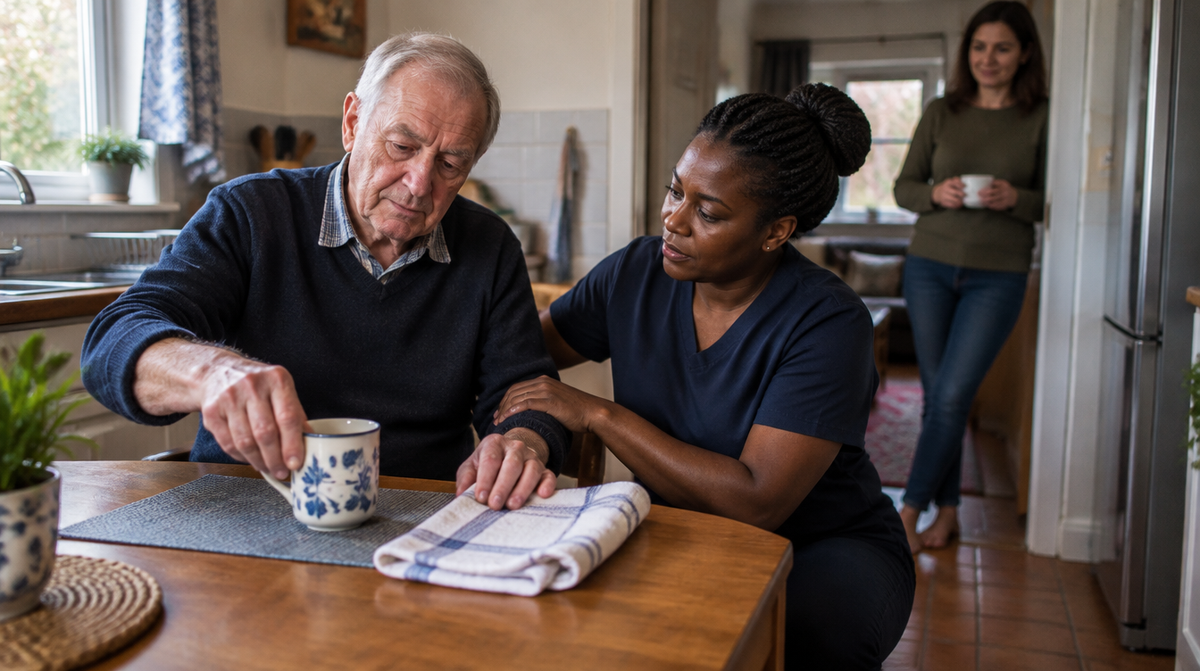
In the first days, this may be as simple as sitting on the edge of the bed. Later it can include standing practice, walking with a stick or frame, and stair training. Physios often teach families how to position the weak arm and leg and how to help someone stand without pulling on the weak arm.
The evidence is encouraging. A Cochrane review by Pollock and colleagues (2014), covering 96 studies and 10,401 participants, concluded that physical rehabilitation is effective for recovery of function and mobility after stroke. It found that a dose of 30 to 60 minutes a day, five to seven days a week, was effective, although the authors cautioned that the evidence on dose is limited.
The same review found no single physiotherapy "approach" was clearly better than the others. What matters is a mix of methods chosen for your loved one's needs.
What does an occupational therapist do after a stroke?
An OT helps your loved one get back to everyday activities, from brushing teeth to cooking a simple meal, and adapts the home or the task when needed. OTs often lead on the weak arm and hand, as well as memory, attention and problem-solving.
The UK Stroke Association explains that OTs assess physical abilities, vision, perception, thinking skills and mood, then use everyday tasks like washing, dressing and cooking to rebuild skills. An OT may visit the home to check chair and bed height, the bath or shower and any steps, and can advise on equipment such as grab rails, shower seats, raised toilet seats and easy-grip cutlery.

A Cochrane review by Legg and colleagues (2017), with nine trials and 994 participants, found that OT focused on daily activities improved people's ability to manage those activities and reduced the risk of deterioration or dependency. The evidence was rated low quality, partly because therapy cannot be "blinded" in trials, but the direction of the results supports OT for stroke survivors living at home.
In South Africa, a 2024 rapid review in the South African Journal of Occupational Therapy, led by Stellenbosch University with the University of the Western Cape, found OTs address upper limb function, cognition, daily living, mobility and community participation. It also highlighted support and training for caregivers, ideally before discharge.
Does your loved one need occupational therapy, physiotherapy or both?
Most people need both, because almost every stroke affects movement and daily tasks together. The mix changes over time.
As a rough guide, physio often takes the lead early on when sitting, standing and walking are the biggest worries. OT becomes especially important as your loved one prepares to go home and wants to do more for themselves. A stroke that mainly affects the hand, memory or concentration may need more OT, while a stroke that mainly affects the leg and balance may need more physio.
Signs your loved one may need more physio
- Unsteady when standing or walking, or has had falls or near-falls.
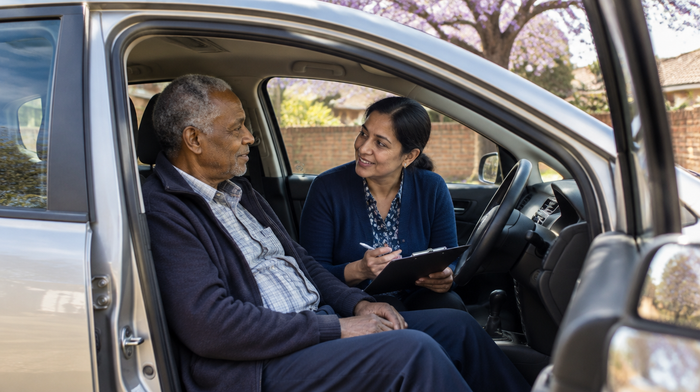
- Struggles to get in and out of bed, a chair or a car.
- The weak leg drags or the knee gives way.
- Stiffness or pain in the shoulder, hip or knee.
Signs your loved one may need more OT
- Can walk, but struggles to dress, wash, eat or prepare food.
- The weak hand is hardly used, or the hand is getting tighter.
- Forgets steps in familiar tasks, or seems confused or easily distracted.
- The bathroom or kitchen is not safe, or they want to return to work.
A speech therapist is also part of many stroke teams, helping with speech, understanding language and swallowing. If your loved one coughs when eating or drinking, or struggles to find words, ask for a speech therapy referral too.
How do you get OT and physio in South Africa?
Ask the hospital team before discharge which therapists your loved one needs, and for referrals to continue therapy afterwards. The need is large: the Heart and Stroke Foundation South Africa (2023) reports that about 10 people have a stroke every hour in the country, and about a quarter of people who have a stroke are left with a life-changing disability.
- Public sector: ask the ward team or your local clinic for an outpatient physio and OT referral. Availability differs between hospitals and districts, so ask what is offered close to home.
- Private sector: a doctor's referral is not always required, but it can help with medical aid. Check your plan's rehab or day-to-day benefits first, as both therapies usually come from the same pool. Our guide to stroke rehab costs and medical aid explains what to ask your scheme.
- Check registration: physiotherapists and occupational therapists in South Africa should be registered with the Health Professions Council of South Africa (HPCSA). It is fine to ask.
- Ask about home visits or video sessions if travel is difficult.
What if you can only get one type of therapy?
Work with the therapist you have and ask them to cover the gaps.
Ask for a written home programme that includes movement practice and daily tasks, such as using the weak hand to hold a cup or help with dressing. Keep practice short and regular, and write down what was done. Our guide on what to do when physio ends after a stroke has a handover checklist you can take to the last session.
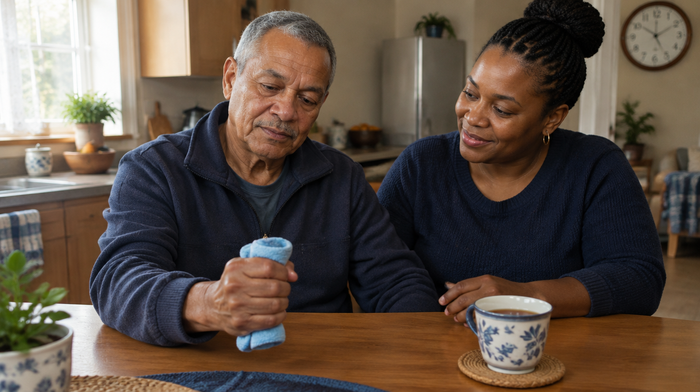
Keep the weak hand involved every day, because hands often get left out once formal therapy stops. Some families also use a rehab glove, such as Mirra, to help with daily hand repetitions. Check with your OT or physio first that it suits your loved one.
When should you call a doctor or therapist?
- Walking, balance or use of the arm is getting worse instead of better.
- Falls or near-falls at home.
- New or worsening pain, especially in the weak shoulder.
- The hand or arm is getting tighter and harder to open or straighten.
- Coughing or choking when eating or drinking.
- Low mood, withdrawal, or you as the carer are struggling to cope.
- Any new stroke signs are an emergency: face drooping, sudden arm or leg weakness, slurred speech, sudden loss of balance or vision. Call an ambulance straight away (10177, or 112 from a cellphone). Our BE FAST guide explains what to do.
Frequently asked questions
Is occupational therapy or physiotherapy better after a stroke?
Neither is better; they do different jobs. Physio focuses on movement and walking, while OT focuses on daily tasks, the hand and thinking skills. Most stroke survivors benefit from both, and the balance shifts as recovery goes on.
Who helps with hand recovery after a stroke, the OT or the physio?
In many teams the OT leads on the hand and fine movements, while the physio focuses on the shoulder, trunk and walking. In practice both may work on the arm, so ask your team who is responsible for the hand programme.
How long will my loved one need OT and physio?
It varies with the size of the stroke, your loved one's goals and what services are available. Some people need a few weeks of therapy, others need months with reviews over time. Ask the team to set goals and review them regularly.
Sources
- Cochrane. Pollock A, Baer G, Campbell P, et al. Physical rehabilitation approaches for the recovery of function and mobility following stroke. Cochrane Database of Systematic Reviews, 2014.
- Cochrane. Legg LA, Lewis SR, Schofield-Robinson OJ, Drummond A, Langhorne P. Occupational therapy for adults with problems in activities of daily living after stroke. Cochrane Database of Systematic Reviews, 2017.
- Engelbrecht M, van der Walt J, van Biljon H, Soeker S. South African Journal of Occupational Therapy, 2024, reported in Occupational therapists' key role in rehabilitation of stroke survivors, Bizcommunity, 2024.
- Northern Care Alliance NHS Foundation Trust. Stroke rehabilitation: how therapists help patients regain independence, 2025.
- Stroke Association (UK). Occupational therapy after stroke (undated).
- Heart and Stroke Foundation South Africa. World Stroke Week 2023 press release, 2023.
Keep the hand practising every day
Try Mirra at home for 30 days, with free tracked delivery anywhere in South Africa.
Try Mirra at home