
What Hand Exercises Can You Do at Home After a Stroke?
In this guide
This is general information, not medical advice. Always follow the home programme and guidance of your loved one's doctor, physiotherapist or occupational therapist.
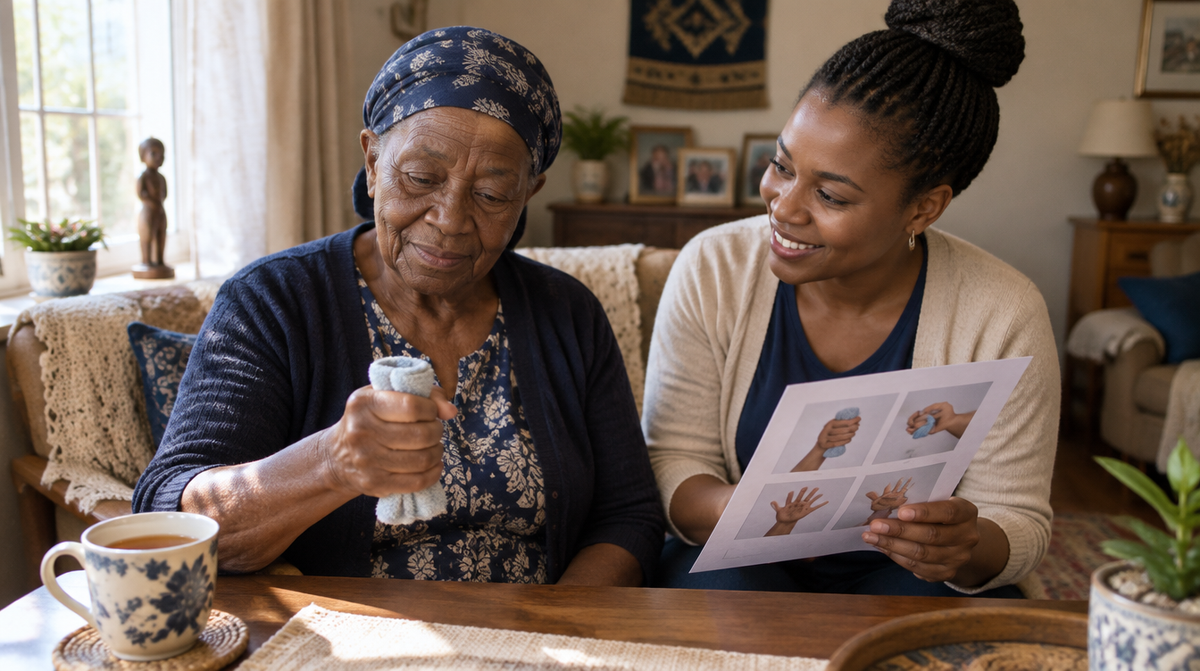
Once your loved one is home after a stroke, the hand can easily get forgotten, especially if it is weak, stiff or curled. This guide gives you gentle, practical hand exercises you can do together at home, matched to how much the hand can move, plus how to keep them safe and part of your daily routine.
Key takeaways
- Safe home hand exercises range from gentle stretching for a hand that can't move yet, to everyday tasks like flipping cards or lifting a bottle for a hand that can.
- Repetition matters most: a Cochrane review (2016) found that practising real tasks over and over improves arm and hand function, though the evidence is low quality.
- Ask the physio or OT to choose the exercises, show you the technique and write down how many to do.
- Short sessions spread through the day are easier to keep up than one long session.
- Never force a stiff joint. Stop if there is pain, and treat any new stroke symptoms as an emergency.
Why do hand exercises matter after a stroke?
The brain relearns movement through repetition, so the hand needs regular, focused practice to have the best chance of improving. Without it, the strong hand tends to take over and the weak one gets used less and less.
A Cochrane review (French and colleagues, 2016) looked at 33 trials with 1,853 people. It found that repetitive task training, which means practising a whole, useful task over and over, improved arm function and hand function. The evidence was low quality and the gains were small, but where they were measured, improvements lasted up to six months.
The amount of practice matters. In the UK, NICE guidance (2023) recommends that stroke rehab should be offered for at least 3 hours a day, at least 5 days a week, where the person needs it and can manage it. Few South African families can get anything close to that through formal therapy, which is why practice at home makes such a difference.
What should you check before starting?
Before you begin, make sure the exercises are approved by your loved one's physio or OT and that the hand and arm are comfortable. A few minutes of preparation prevents most problems.
- Get a written programme. Ask which exercises, how many repetitions, how often, and what to avoid. A phone video of the therapist demonstrating is very useful.
- Check the hand. Look for swelling, redness, broken skin or new pain. If you see any, don't exercise that day and ask for advice.
- Support the shoulder. Rest the weak arm on a table or pillow. Never pull on the arm or lift it by the wrist, because the shoulder on the weak side is easily injured.
- Choose a good time. Practise when your loved one is rested, not straight after a big meal or when they're exhausted.

Which hand exercises can you do at home?
The right exercises depend on how much the hand can do right now. Use this table as a starting point to discuss with your therapist, then work through the matching exercises below.
| What the hand can do | Type of exercise | Examples |
|---|---|---|
| Little or no movement, or fingers curled | Passive (you move it gently) | Supported finger and thumb stretches, wrist movement, mirror therapy |
| Some movement, but weak | Assisted (the person tries, you help) | Finger lifts on the table, face cloth scrunch, finger-to-thumb touches |
| Can grip and release | Active, task-based | Flipping cards, lifting a bottle, wringing a cloth, putting away groceries |
1. Supported finger and thumb stretches (passive)
Rest the forearm on the table, palm down or on its side. Hold the wrist steady with one hand. With your other hand, slowly straighten the fingers together as far as is comfortable, hold for a few seconds, then release. Do the same gently for the thumb, easing it away from the palm. Never push into pain or force a tight joint.
2. Finger lifts on the table (assisted)
With the palm flat on the table, ask your loved one to lift each finger, one at a time, then put it down. If a finger won't lift, help it up and let them try to hold it there for a moment.
3. Finger-to-thumb touches
Touch the tip of the thumb to each fingertip in turn, then go back the other way. Go slowly. Accuracy matters more than speed.
4. Face cloth scrunch and squeeze
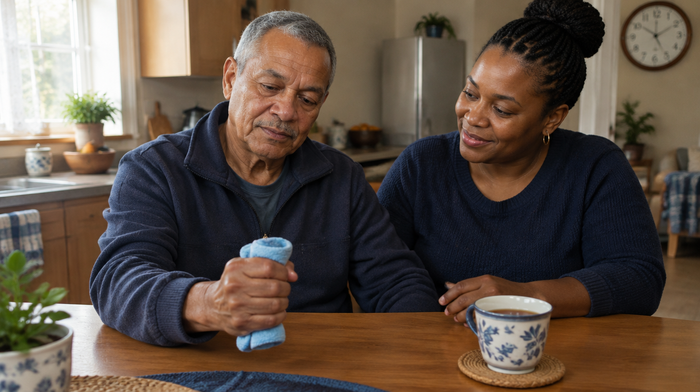
Lay a face cloth flat on the table. Use the fingers to scrunch it into the palm, then push it flat again while straightening the fingers. For a harder version, roll the cloth up and squeeze it with all the fingers and thumb, or wet it and wring it out over a basin.
5. Flipping cards
Spread a deck of playing cards face down. Ask your loved one to pinch each card and turn it face up using the weak hand. This trains the small pinch grip used for buttons and coins.
6. Lifting a water bottle
Stand a half-full plastic bottle upright on the table. Grasp it, lift it towards the chin, then put it back down. When this gets easier, try taking a sip.
7. Putting away groceries
Pick up a tin, move it to another spot on the table, then progress to placing it on a low shelf, and later a higher one.
Exercises 4 to 7 come from occupational therapists at Baystate Health (2022). If the hand can't move yet, mirror therapy is another option to discuss. See our guide to what mirror therapy is and whether it works.
How often and for how long should you practise?
Follow your therapist's numbers first. If you don't have them yet, short, regular sessions are a sensible starting point: two or three sessions of 10 to 15 minutes a day, most days of the week.
Start with a few repetitions of each exercise and build up slowly as your loved one gets stronger. Some tiredness is normal. Pain, swelling or exhaustion the next day means you've done too much, so ease back and let the therapist know.
How can you make home exercises stick?
The best programme is the one that actually gets done. Link practice to things that already happen every day, and keep it as easy as possible to start.
- Anchor it to routines. After breakfast, during the evening news, or while the kettle boils.
- Keep a kit ready. A small box with a face cloth, cards, a bottle and a tin, left on the table where you practise.
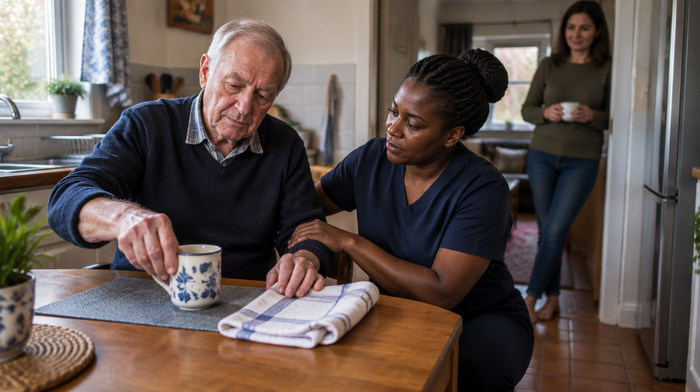
- Use the hand in daily life. Holding a cup with both hands, steadying a plate, or resting the hand on the table at meals all add extra practice.
- Track progress. Note how many cards they flipped or how long they held the bottle. Small wins keep everyone motivated, and the notes help the therapist at reviews.
- Share the load. If several family members help, give each one a simple written copy of the programme.
For more on why the hand is often slowest to recover, read our guide to helping a loved one's hand recover at home.
When should you call a doctor or therapist?
- Pain in the hand, wrist or shoulder that starts or gets worse with exercise.
- Swelling, redness, heat or broken skin on the weak hand or arm.
- The fingers or wrist becoming tighter or more curled over a few weeks.
- No progress at all after several weeks of regular practice, so the programme can be reviewed.
- Any sudden new weakness, numbness, facial drooping, slurred speech, confusion or vision problems. This is an emergency: call an ambulance straight away.
Frequently asked questions
Is a squeeze ball good for hand exercises after a stroke?
It can be, but not for everyone. If the fingers tend to curl tightly or the hand is spastic (stiff and tight because of the stroke), squeezing may not be the right exercise. Ask the physio or OT whether it suits your loved one.
Can we do hand exercises if the hand can't move at all?
Yes. Gentle passive stretches, where you move the fingers for them, help keep the joints moving, and mirror therapy can be tried even when the hand barely moves. Some families also use a rehab glove, such as Mirra, to help with daily repetitions. Get the therapist to show you the technique first, and check with them before trying any device.
How long should we keep doing the exercises?
For as long as they help. Recovery is usually fastest in the first months, but many people keep making gains with practice for much longer. Ask for a programme review every few months so the exercises stay right for your loved one's level.
What if we can't get to a therapist regularly?
Ask for at least one review appointment to set up or update the home programme, and record the therapist demonstrating each exercise. It is also worth asking whether the practice offers telephone or video follow-ups.
Sources
- Cochrane: French B, Thomas LH, Coupe J, et al. Repetitive task training for improving functional ability after stroke. Cochrane Database of Systematic Reviews, 2016.
- NICE (National Institute for Health and Care Excellence). People who have had a stroke should be offered additional rehabilitation, guideline NG236, 2023.
- Baystate Health. Hand exercises: an important step toward stroke recovery, 2022.
- Cochrane: Thieme H, et al. Mirror therapy for improving motor function after stroke. Cochrane Database of Systematic Reviews, 2018.
Keep the hand practising every day
Try Mirra at home for 30 days, with free tracked delivery anywhere in South Africa.
Try Mirra at home