
How Long Does Hand Recovery Take After a Stroke?
In this guide
This guide is general information, not medical advice. Always follow the guidance of your loved one's doctor, physio or occupational therapist (OT).
If Mum, Dad or your partner has had a stroke, one of the first questions you probably asked was: will the hand come back, and how long will it take? It is a hard question to sit with, especially when nobody can give you an exact date.
This guide explains what the research says about the usual timeline, what tends to help, and what you can do at home to support the process.
Key takeaways
- There is no single timeline. Every stroke is different, and the hand often recovers more slowly than the leg or the shoulder.
- The most noticeable recovery usually happens in the first three months, and progress tends to slow after about six months (Johns Hopkins Medicine).
- Recovery does not simply stop at six months. A UK study of 224 people who were a median of 18 months after their stroke still found meaningful gains in arm and hand function after intensive therapy (Ward and colleagues, 2019).
- Early signs matter: people who can lift the shoulder sideways and straighten the fingers a little in the first few days have a much better chance of regaining some hand use (EPOS study, 2010).
- Regular, repeated practice between therapy sessions, guided by your physio or OT, is one of the most useful things a family can support at home.
How long does hand recovery take after a stroke?
For most people, the fastest hand and arm recovery happens in the first three months after a stroke, with slower progress continuing for months or even years. Johns Hopkins Medicine describes the first three months as the critical period for rehabilitation, and notes that "there is no expiration date for stroke recovery".
The UK Stroke Association says the same thing in simpler words: recovery is fastest in the first few months, but many people carry on making improvements for much longer.
So when a therapist says "we will have a better idea at three months" or "let's see where we are at six months", they are not giving up. They are working with the way the brain usually heals.
A rough timeline families can expect
| Stage | What often happens | What families can do |
|---|---|---|
| First days to weeks | The hand may be floppy or very weak. Swelling and tiredness are common. | Ask the team how to position the arm safely. Watch for any small movement in the fingers or shoulder. |
| Weeks to 3 months | Usually the period of quickest change. Some movement may return, often starting at the shoulder and elbow before the fingers. | Attend every therapy session you can. Ask for a written home programme. |
| 3 to 6 months | Progress is often still steady, but slower. | Keep up daily practice. Ask whether outpatient therapy can continue. |
| 6 months and beyond | Change is slower and depends heavily on practice and therapy. | Build a home routine that sticks, and ask for review appointments. |
These stages are a general guide only. Your loved one's own team is the best judge of where they are.
Why does the hand often recover more slowly than the leg?
The hand needs very fine, precise control, so it usually takes longer to recover than bigger movements like walking. Picking up a teaspoon or doing up a button uses many small muscles working together, and that coordination depends on nerve pathways that a stroke can easily damage.
Many families notice their loved one walking again before they can use the hand properly. That is common, and it does not mean the hand will never improve.
Learned non-use: when the strong hand takes over
Learned non-use is when a person stops trying to use the weak hand because the strong hand is quicker and easier. Over time, the weak hand gets even less practice. This is one reason therapists keep encouraging the weak hand to join in daily tasks, even in small ways, such as holding a cup steady while the strong hand pours.
What signs suggest the hand is likely to recover?
Early movement in the fingers and shoulder is one of the strongest signs that some hand use is likely to return. In the Dutch EPOS study (Nijland and colleagues, published in Stroke, 2010), people who could straighten their fingers a little and lift their shoulder sideways on day two after the stroke had a 98% chance of regaining some dexterity at six months. Without those movements, the chance was 25%.
The same study found that 60% of people who had some finger extension early on had made a full recovery on a standard arm test at six months.
If your loved one did not have early movement, please do not lose heart. A lower chance is not no chance, and therapists use these signs to plan treatment, not to write anyone off. Ask the physio or OT what they have observed and what that means for your loved one.

Can the hand still improve a year or more after a stroke?
Yes, improvement is still possible later on, although it is usually slower and needs a lot of practice. In a 2019 study from the Queen Square Upper Limb clinic in London, 224 people who were a median of 18 months after their stroke took part in an intensive programme of 90 hours of therapy over three weeks (Ward and colleagues, Journal of Neurology, Neurosurgery and Psychiatry, 2019).
Most participants showed meaningful gains in arm and hand function, and the gains continued during the six months after the programme ended. The study did not have a comparison group, and the programme was far more intensive than most people can access, so it does not promise the same result for everyone. What it does show is that the door does not close at six months.
In South Africa, where many families find that funded physio ends quite early, this is an important message. Our guide on what to do when physio ends after a stroke covers practical next steps.
What can families do at home to support hand recovery?
The most helpful thing families can do is support regular, repeated practice of the exercises the therapist has prescribed. The Stroke Association notes that practising activities regularly in between therapy sessions can help people reach their goals.
1. Ask for a written home programme
Ask the physio or OT to write down which exercises to do, how many times and how often. Take a short video on your phone during the session so you remember the technique.
2. Little and often
Several short sessions spread through the day are usually easier to manage than one long one, especially because tiredness after a stroke is very common. Check the right amount with the therapist.
3. Bring the weak hand into daily life
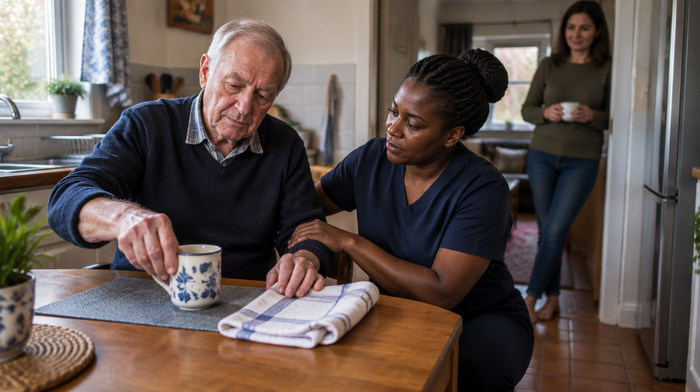
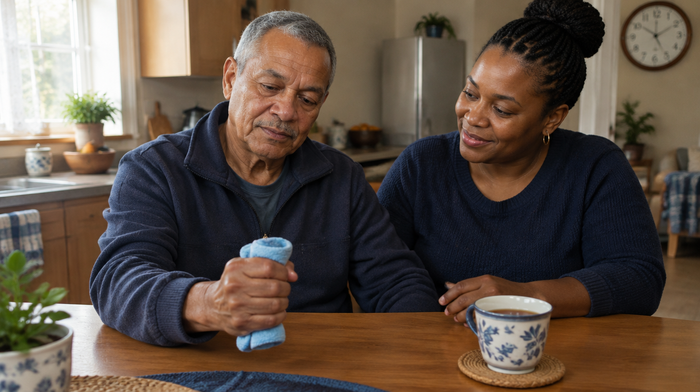
Encourage the weak hand to help with safe, everyday tasks: steadying a plate, holding a face cloth, or turning a page. This helps fight learned non-use.
4. Track small wins
Keep a simple notebook of what your loved one can do each week. Progress in the hand can be slow, and a written record helps everyone see change that is easy to miss day to day.
5. Protect the shoulder and watch the hand
Never pull on the weak arm. Tell the therapist about stiffness, swelling, pain or a hand that keeps clenching. Our guide on hand exercises you can do at home after a stroke has more ideas to discuss with your therapist.
Where can a rehab glove fit in?
A rehab glove can be one way to help with the many repetitions that hand recovery needs, alongside, not instead of, your loved one's therapy. Some families find it hard to keep practice going every day once formal sessions end, and a glove can make home practice more structured.
Mirra is an at-home hand rehab glove with a mirror mode, where a sensor glove on the stronger hand guides the weaker hand through gentle, matching movements. It is designed to support practice, not to cure or guarantee recovery, and results differ from person to person. Before starting, check with the treating physio, OT or doctor that it suits your loved one, especially if there is pain, swelling or strong spasticity. You can read how the Mirra glove works.
Mirra home hand practice
Recovery takes time. Keep the hand practising.
Mirra's mirror mode lets the good hand guide the weak one through gentle, repeated movements every day, alongside your therapist's advice. Free tracked delivery anywhere in South Africa and a 30-day home trial.
Not sure if it's right for your family? Ask us a question
When should you call a doctor or therapist?
- Call an ambulance immediately (10177 from a landline, 112 from a cellphone, or your private ambulance service) if you see new stroke signs: face drooping, sudden arm weakness, slurred speech, sudden loss of balance or vision.
- The hand or arm suddenly becomes weaker than it was.
- The hand or arm becomes very swollen, hot, red or painful.
- Shoulder pain is getting worse or stopping your loved one from sleeping.
- The fingers are clenching more tightly and are hard to open.
- Any exercise causes pain, or your loved one seems confused or unusually drowsy.
Frequently asked questions
Is there a cut-off point after which the hand will not improve?
No fixed cut-off has been shown. Progress is usually fastest in the first three months and slows after six months, but research such as the Queen Square study (2019) shows that people can still improve well after a year with enough focused practice.
My dad still can't move his fingers after a month. Is that a bad sign?
No early finger movement can mean a slower or less complete recovery, but it is not a final answer. Every stroke is different. Ask his physio or OT what they are seeing, what goals are realistic and how you can help at home.
How many hours a day should my mum practise?
There is no single right number for everyone. The amount depends on her energy, other health conditions and her therapist's plan. Ask the therapist for a specific number of repetitions or minutes per day, and build up slowly.
Does the hand recover in the same order as the arm?
Often, movement returns at the shoulder and elbow before the wrist and fingers, but this is not true for everyone. Your loved one's therapist can explain the pattern they are seeing.
Sources
- Johns Hopkins Medicine, Stroke recovery timeline (accessed 2026)
- Stroke Association (UK), Physical effects of stroke (accessed 2026)
- Nijland R, van Wegen E, Harmeling-van der Wel B, Kwakkel G. Presence of finger extension and shoulder abduction within 72 hours after stroke predicts functional recovery: the EPOS cohort study. Stroke, 2010
- Ward NS, Brander F, Kelly K. Intensive upper limb neurorehabilitation in chronic stroke: outcomes from the Queen Square programme. Journal of Neurology, Neurosurgery and Psychiatry, 2019
- University College London, New study suggests effective rehabilitation possible for chronic stroke patients (2019)
- NHS, Stroke: recovery (accessed 2026)
Keep the hand practising every day
Try Mirra at home for 30 days, with free tracked delivery anywhere in South Africa.
Try Mirra at home