
Why Does the Strong Hand Take Over After a Stroke? (Learned Non-Use)
In this guide
This guide is general information, not medical advice. Always follow the advice of your loved one's doctor, physio or occupational therapist (OT).
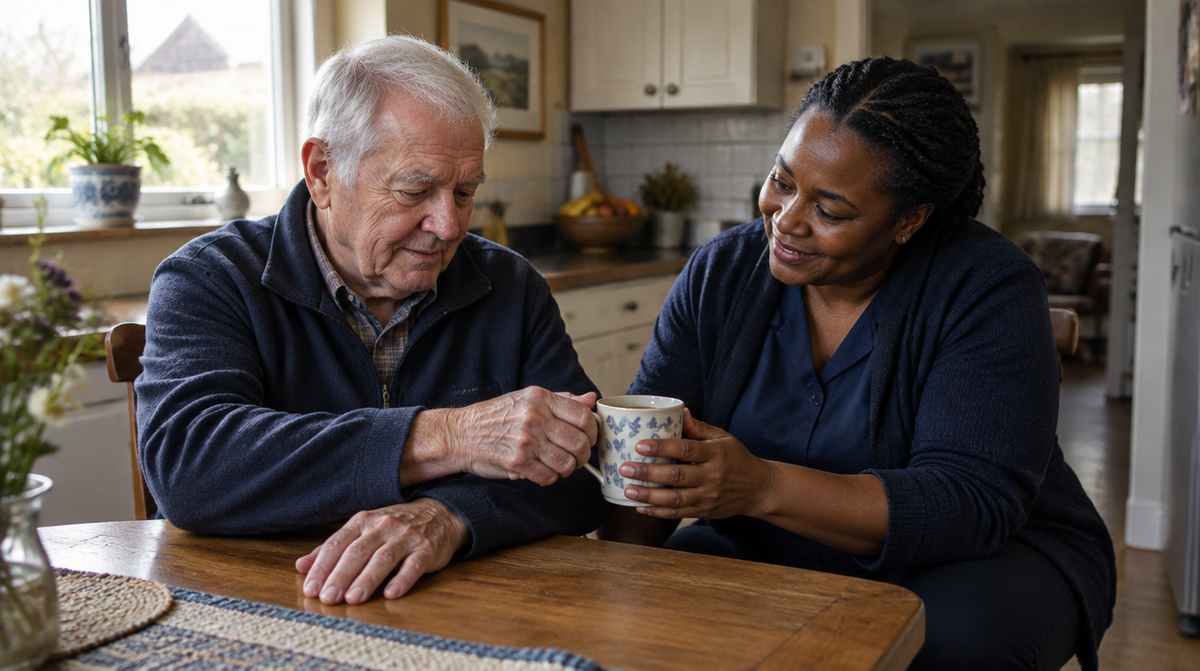
You may have noticed that Mum or Dad now does almost everything with their "good" hand, even when the weaker hand can move a little. They pour tea, button shirts and open doors one-handed, and the weaker hand just rests in their lap. This guide explains why that happens, why it matters, and what your family can do about it at home.
Key takeaways
- When the strong hand takes over after a stroke, therapists call it "learned non-use": the weaker arm stops being used out of habit, even when it can move.
- It usually starts with real weakness, numbness or pain, then becomes a habit because the strong hand is faster and easier.
- Researchers describe a cycle where more use of the weaker arm tends to support better function, and less use can let hard-won gains slip (Frontiers in Neurology, 2022).
- Therapy that pushes the weaker arm to do more, such as constraint-induced movement therapy, improved arm movement in a Cochrane review, though the evidence is low quality (Cochrane, 2015).
- At home, families can help by setting up safe, small jobs for the weaker hand every day, as part of the programme the physio or OT gives you.
Why does the strong hand take over after a stroke?
The strong hand takes over because, straight after a stroke, the weaker hand is slow, clumsy or numb, so the brain learns that using the good hand "works better". Over time this becomes a habit, and the weaker hand gets left out even when it has some movement back.
Therapists call this learned non-use. A 2015 review in Physical Medicine and Rehabilitation Clinics of North America (Raghavan, NYU) describes it simply: non-use may begin because of weakness, paralysis or loss of feeling, and then "becomes a learned behavior".
Things that feed it include:
- Weakness, the key early problem, according to the review.
- Loss of feeling, so the hand can't sense what it's holding.
- Pain, which can cause avoidance that carries on even after the pain has gone.
- Not moving, which can lead to stiffness, tight muscles and more pain.
None of this is laziness. Your loved one may not even notice they're doing it.
Why does it matter if the weaker hand isn't used?
It matters because recovery depends a lot on practice, and the weaker hand only gets practice when it's actually used. If it sits still all day, it can lose ground it has already gained in therapy.
Researchers describe this as two possible cycles (Ballester, Winstein and Schweighofer, Frontiers in Neurology, 2022):
- A "virtuous cycle": if arm use stays above a certain level, everyday use acts like extra practice, function improves, and the person uses the arm even more.
- A "vicious cycle": if use drops too low, non-use and poor movement feed each other, and gains from rehab can be lost. The authors call this "rehabilitation in vain".
In one large trial they reanalysed (EXCITE), about two-thirds of people whose arm function was above a certain level went on to use their arm more over time. The paper also notes that people tend to use the weaker arm more readily in two-handed tasks than in one-handed ones. That's a useful clue for families: two-handed jobs are often the easiest place to start.
That's why the end of formal therapy can be a risky time. See our guide on what to do when physio ends after a stroke.
How do therapists treat learned non-use?
The best-known treatment is constraint-induced movement therapy (CIMT), where the strong hand is restrained in a mitt or sling so the weaker arm has to do the work, combined with lots of structured practice. It's only suitable for some people and should be planned and supervised by a therapist.
Here's what the evidence says:
- A Cochrane review (Corbetta and colleagues, 2015) looked at 42 studies with 1,453 people. CIMT improved movement of the affected arm more than other physio or no treatment, but did not clearly improve daily tasks like dressing or eating. The quality of the evidence was rated low to very low.
- The people in those studies could already open their hand by lifting the wrist and fingers. CIMT isn't designed for a hand that has no movement at all.
- The 2022 Frontiers in Neurology paper notes that classic CIMT suits only about 15% of stroke survivors, because it's intensive and needs some hand movement to start with.

For everyone else, therapists use the same idea more gently: extra repetitions, two-handed tasks and "homework" in daily life. Please don't tie or strap the good hand at home without your therapist's say-so, as it can affect balance and safety.
| Approach | What it involves | Who it may suit |
|---|---|---|
| Constraint-induced movement therapy | Strong hand restrained, intensive practice with the weaker arm, therapist-led | People with some wrist and finger movement, chosen by the therapist |
| Two-handed (bilateral) practice | Both hands work together on a task, such as folding or carrying | Many people, including those with limited hand movement |
| Task practice at home | Daily jobs set by the OT, repeated often | Most people, adjusted to ability |
| Mirror therapy | Watching the reflection of the moving good hand while the weaker hand tries to copy | Often used for weaker hands; see our mirror therapy guide |
What can families do at home to stop the strong hand taking over?
The most useful thing you can do is give the weaker hand small, safe jobs every day, so it gets used without turning life into one long exercise session. Ask the OT or physio which jobs are safe for your loved one before you start.
1. Ask the therapist for a "weaker hand job list"
Ask for three to five everyday tasks for the weaker hand. Stick the list on the fridge so everyone in the house, including a carer, follows the same plan.
2. Start with two-handed tasks
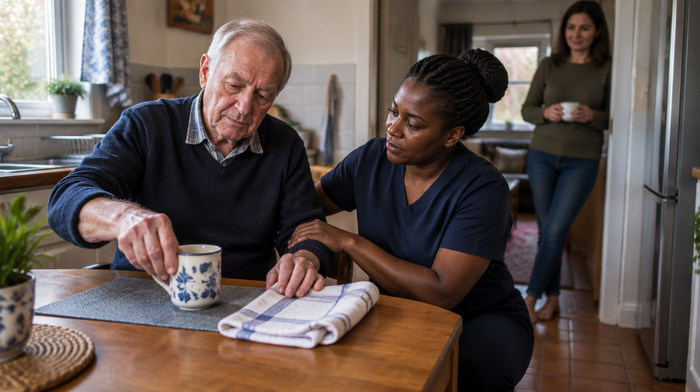
Good starters are often holding a bowl steady while the other hand stirs, folding washing, carrying a towel with both hands, or holding a bread roll while the good hand butters it.
3. Set up the space to invite the weaker hand
Put the TV remote, cup or phone on the weaker side, within easy reach, and sit on that side when you chat.
4. Don't rush in to help
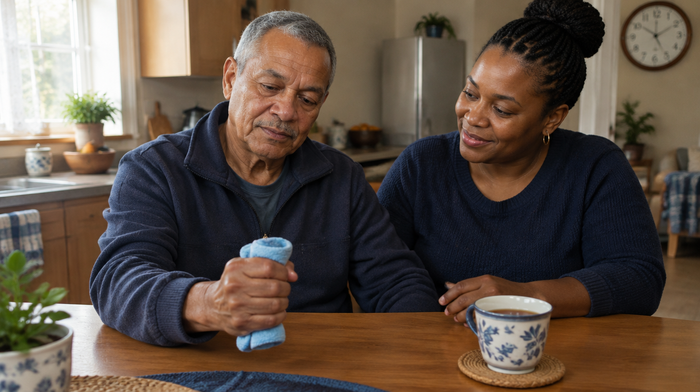
Where it's safe, give extra time and let the weaker hand try first. Praise the effort, not just the result.
5. Keep it short and regular
Several short sessions a day are usually easier to stick to than one long one. Stop if the arm hurts.
6. Protect the arm when it's resting
Support the weaker arm on a pillow or armrest so it doesn't hang. Your therapist can show you safe positions, especially if the shoulder is sore or the hand tends to clench. Our guide on spasticity and a clenched hand explains more.
Is it ever too late to start using the weaker hand again?
Habits can often be changed later on, but how much the hand can recover is different for every person, and only the treating team can judge your loved one's potential. Many people are still worth reassessing months or years after the stroke.
The 2022 Frontiers in Neurology paper warns that function can drift backwards over the years after therapy if the arm isn't used. That's a reason to keep going gently, not a reason to give up. If you're unsure where your loved one stands, ask for a review with an OT or physio. In South Africa, that may be your local hospital's rehab unit or a private therapist your medical aid covers.
Stroke is common here. The Heart and Stroke Foundation South Africa (2023) says about 10 people have a stroke every hour in South Africa, and around a quarter are left with a life-changing disability. You're far from alone in dealing with this.
Where can a rehab glove fit in?
A rehab glove can't replace therapy, but it can add gentle, repeated hand movement on days with no therapist around, alongside the jobs and exercises your physio or OT has set.
Mirra is a mirror-therapy rehab glove: in mirror mode, the strong hand wears a sensor glove and an air-powered glove gently moves the weaker fingers to match, so both hands open and close together. For learned non-use, the appeal is that it involves the weaker hand rather than leaving it out. It won't cure a stroke or guarantee recovery, and it isn't suitable for everyone, so please check with the treating team first, especially if the hand is very stiff, swollen or painful. You can read how the Mirra glove works and take the details to your therapist.
Mirra home hand practice
Give the weaker hand a daily role again
Mirra's mirror mode lets the good hand lead the weak one through gentle, repeated movements, so both hands work together alongside your therapist's advice. Free tracked delivery anywhere in South Africa and a 30-day home trial.
Not sure if it's right for your family? Ask us a question
When should you call a doctor or therapist?
Call an ambulance straight away (10177 from a landline, 112 from a cellphone, or your private ambulance service) if you see any new stroke warning signs: a drooping face, sudden new weakness in an arm or leg, slurred speech, sudden loss of vision or balance, or a sudden severe headache.
Contact the doctor, physio or OT soon if:
- The weaker shoulder, arm or hand becomes painful, swollen, hot or red.
- The hand is clenching more tightly or the fingers are getting harder to open.
- Your loved one has had a fall, or seems less steady when using the weaker arm.
- Movement or use of the weaker hand is getting worse rather than better.
- Your loved one seems very low, frustrated or withdrawn about their recovery.
- You'd like a new home programme or want to ask whether CIMT or other arm therapy could help.
Frequently asked questions
What is learned non-use after a stroke?
Learned non-use is when a stroke survivor stops using their weaker arm or hand out of habit, even though it can move. It usually starts because the arm is weak, numb or painful, and the strong hand simply becomes the easier option.
Should I tie up my parent's good hand so they use the weak one?
No, not without a therapist's plan. Constraint-induced movement therapy is carefully chosen and supervised, and it only suits some people. Restraining the good hand at home can affect balance and safety, so ask the physio or OT first.
How can I tell if my loved one has learned non-use?
Notice whether they can move the weaker hand when asked, but leave it out during everyday tasks. If so, tell the OT or physio, who can test the hand and suggest tasks.
Sources
- Cochrane (Corbetta D, Sirtori V, Castellini G, Moja L, Gatti R), Constraint-induced movement therapy for upper extremities in people with stroke, 2015.
- Raghavan P, Physical Medicine and Rehabilitation Clinics of North America, Upper limb motor impairment post stroke, 2015.
- Ballester BR, Winstein C, Schweighofer N, Frontiers in Neurology, Virtuous and vicious cycles of arm use and function post-stroke, 2022.
- Heart and Stroke Foundation South Africa, World Stroke Week 2023 press release, 2023.
Keep the hand practising every day
Try Mirra at home for 30 days, with free tracked delivery anywhere in South Africa.
Try Mirra at home