For families after a stroke
Why a Stroke Hand Often Stops Improving When Physio Ends, and 7 Things South African Families Wish They'd Known Sooner
It is rarely the hand giving up. It is the daily practice that disappears. Here is what is really happening, and how families keep the hand moving at home.
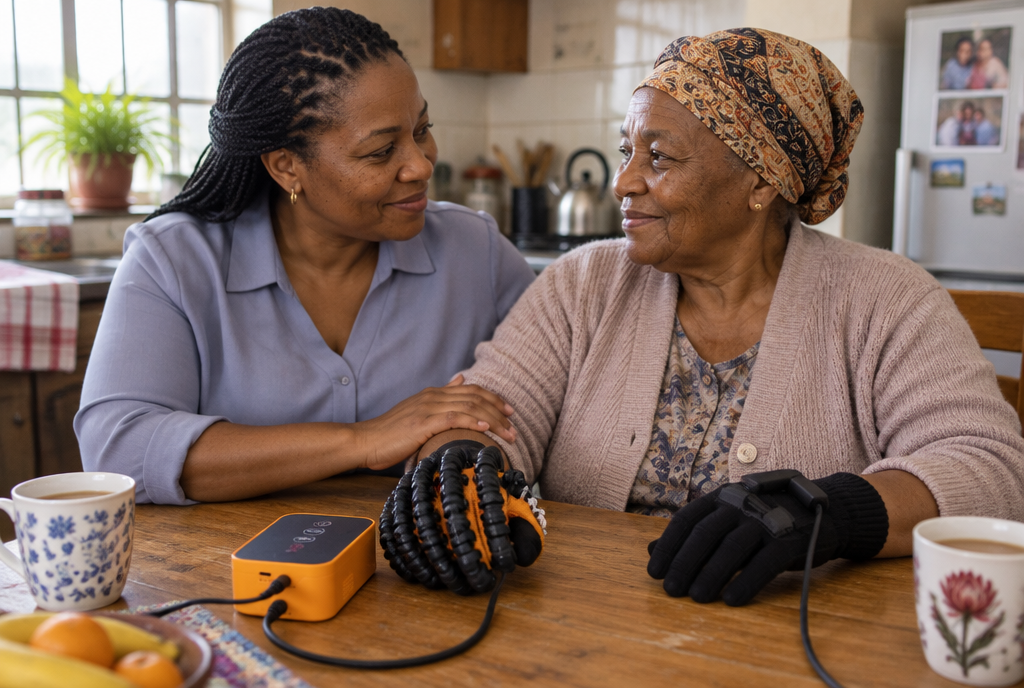
If someone you love has had a stroke, you probably remember the day the physio sessions ended.
Maybe the medical aid letter said the rehab benefits were exhausted. Maybe the physio was kind about it and used the word "plateau". Either way, you went home with a printed exercise sheet, a squeeze ball, and a hand that still would not open.
Months later, the fingers are curling a little tighter. You do the exercises when you can. Some nights you cannot. And underneath everything sits one quiet question: is this as good as it gets?
We went through the stroke research and the stories caregivers share online to answer that question honestly. Here is what families told us they wish someone had explained on day one.
1"Plateau" often means the cover ended, not the recovery
Many families hear the word plateau at the exact moment the benefits run out. That timing is not a coincidence.
The belief that most recovery happens in the first three months goes back to a study published in 1951. Newer research has recorded hand and arm improvements months and even years after a stroke. In one documented case, a man's hand began improving 23 years after his stroke with intensive glove-based therapy.
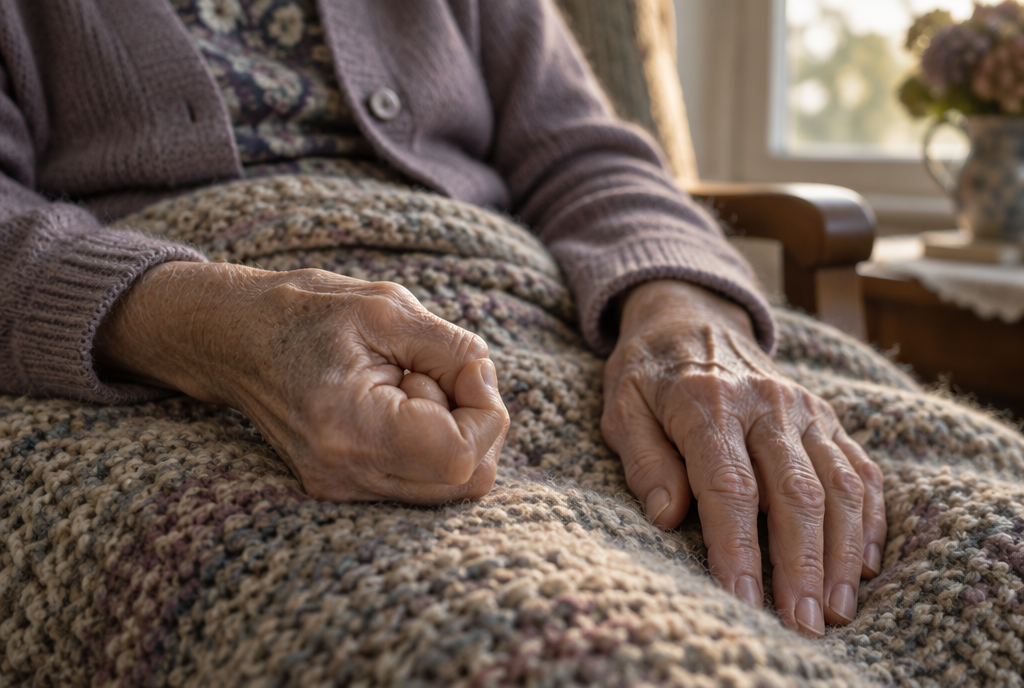
Every stroke is different, and nobody can honestly promise how far a hand will go. But plateau is not the same word as finished.
2The missing piece is called the Repetition Gap
The brain relearns hand movement the same way a child learns to write: through repetition. Not a few movements a week. Hundreds, every day, for months.
In rehab, the hand gets that daily practice. Then the sessions drop to twice a week, then to an exercise sheet, then to almost nothing. When researchers counted the hand and arm movements in real therapy sessions, the numbers were in the dozens. The recovery research is built on hundreds.
That difference is the Repetition Gap. The hand often does not stall because it cannot improve. It stalls because the daily repetitions stopped.
Where the practice goes after a stroke
Illustration of the pattern families describe, not measured data.
The hand doesn't recover from a few sessions a week. It recovers from hundreds of movements a day, and nobody tells you that when physio stops.
The idea behind Mirra
3The squeeze ball was never going to work
Squeeze balls, putty and exercise sheets all assume the hand can already move. A curled hand cannot squeeze a ball, so the repetitions never happen. The ball ends up on the bedside table, gathering dust next to the reading glasses.
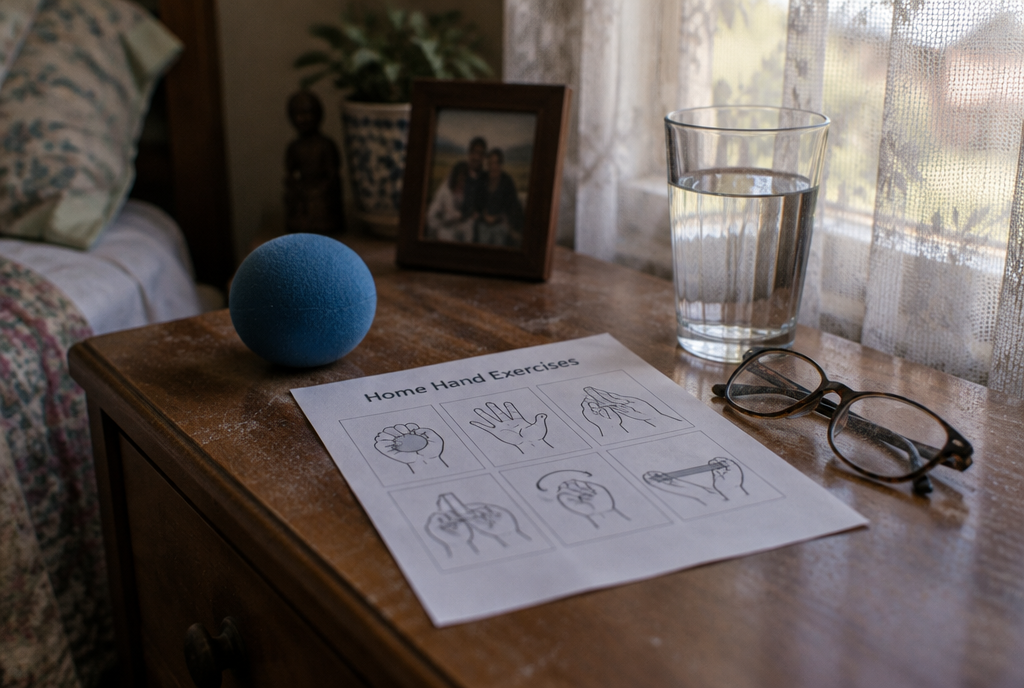
That is not a lack of effort from your mom, your dad or you. It is the wrong tool for a hand that cannot move on its own yet.
4The good hand quietly takes over
When one hand is slow and frustrating, the other hand starts doing everything because it is quicker. Ten minutes on one button becomes ten seconds with the good hand. Over time, the brain stops reaching for the weak hand at all.
Scientists first described this in 1895. Today it is called learned non-use. The stiffness and curling many families notice is often part of the same pattern: a hand that is not moved, stops moving.
5A 100-year-old experiment pointed to the answer
In 1917, two researchers, Ogden and Franz, worked with monkeys that had stopped using one hand after a brain injury. When the good arm was restrained and the weak hand was coaxed to move, again and again, the weak hand came back in about three weeks.
The idea was largely forgotten until the 1980s, when it returned as constraint-induced therapy, now one of the most studied approaches in stroke rehab. The lesson has not changed in a century: the weak hand needs to be used, over and over.
This is history, not a promise about any product or any one person's recovery.
6You can't be her therapist every day. You shouldn't have to be.
Most caregivers already know what the hand needs. The problem is time. There is work, the children, the traffic, the medical aid calls, and your own life slipping quietly out of reach.
Doing hundreds of gentle movements with her every evening is not realistic. Skipping them leaves you lying awake feeling guilty. That guilt is not fair. You are not failing her. The system simply left the hardest part to you.
This is exactly the gap we built Mirra to fill.
Meet Mirra
Daily guided hand practice at home, without strength or a therapist
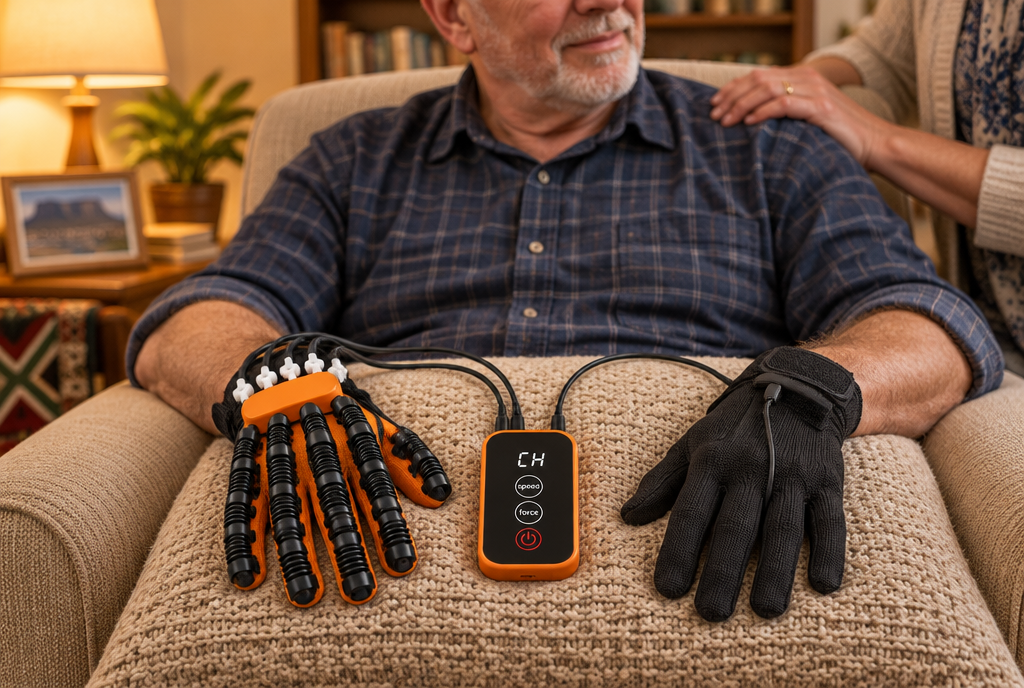
- 1The good hand leads
A light sensor glove on the stronger hand reads every time it opens and closes.
- 2The weak hand follows
A soft, air-powered glove gently opens and closes the other hand the same way, at the same time. Passive modes move fingers that cannot move on their own yet.
- 3Ten to twenty minutes, from a favourite chair
One button starts the session. Practice happens in front of the TV, with no driving, no queues and no effort from you.
Designed for home practice alongside physio, not as a replacement for it. Check with your doctor or physio first if there is pain, swelling or broken skin.
 Everything includedHome Recovery kit
Glove set, support belt, practice plan ebook, exercise ball and a 2-year warranty. Free delivery in SA.
R2,599.99
7It costs less than one month of private physio
Once medical aid stops paying, private hand therapy in South Africa is often around R700 a session. Twice a week, that is about R5,600 every month, for as long as you can keep it up.
Private physio
R5,600
per month, at 2 sessions a week
Mirra Home Recovery
R2,599.99
once off, yours to keep, 30-day home trial
Today's offer for South African families
Give the hand its daily practice back
Choose the hand and size, and we will deliver free to your door.
1Your kit
2Which hand needs help?
3Glove size
Not sure? WhatsApp us a photo of the hand next to a ruler and we will tell you which size fits.
In stock in Sandton. Free delivery in 3 to 7 working days
Try it at home for 30 days
Use Mirra every day for a month. If it isn't right for your family, WhatsApp us and send it back for a full refund.
What happens after you order
- Your ebook arrives by email straight away.
- We confirm the size with you on WhatsApp if you are unsure.
- Your kit ships from Sandton with free tracked delivery, usually in 3 to 7 working days.
- You have 30 days to try it at home.
Questions families ask
We were told the hand has plateaued. Is it too late?
Not necessarily. Research has recorded improvements months and years after a stroke, and progress often slows because the practice slowed. Every stroke is different, so ask your physio what to expect.
The hand barely moves. Will it still work?
Yes, that is what the passive modes are for. The glove gently opens and closes fingers that cannot move on their own. If the hand cannot be gently straightened at all, or it hurts to try, check with a doctor or physio first.
I don't have time to do exercises every day.
That is exactly why families choose it. Once the gloves are on, one button starts the session, so practice can happen in front of the TV without you doing every movement by hand.
Does it hurt?
It should not. You control the speed and force and can stop any time. If there is any pain, stop and check with your physio.
Does it replace physio?
No. Mirra keeps the hand practising between sessions or after therapy ends. It works best alongside your physio's advice.
What if it isn't right for us?
You have 30 days from delivery. WhatsApp us and send it back for a full refund.
The hand didn't stop. The practice did.
If your mom, dad, husband or wife is sitting at home with a hand that will not open, and someone has told you this is as good as it gets, it might not be the end of the road. It might just be the end of the repetitions.
This page is an advertorial published by Mirra. It is general information to support home practice and is not medical advice. Mirra is designed for home practice alongside professional care and does not replace your doctor, physiotherapist or occupational therapist. Results vary from person to person and no outcome is guaranteed. Research referenced describes the repetition principle in stroke rehabilitation, not results from Mirra specifically.